

 Written By: Manaswini Vijayakumar
The e-waste ecosystem is a layered challenge that requires an equally nuanced set of responses. The weakest link in this chain is undoubtedly the leachates – elusive and pernicious- with a direct impact on both the people and environment.
Although under-regulated, the matter of leachates is gaining prominence as the widespread negative impact becomes more evident. Our water gets more poisoned by the day, finding its way into everything we consume and do. There are existing measures to address leachates; it’s not as though the problem is completely ignored.
The first and most logical step would be to try to prevent leachates from leaking out altogether. In this phase, lining disposal landfills or redirecting/controlling runoff could be a preliminary step. Chemical treatments such as precipitation and coagulation/flocculation are common in large industrial setups. In this process, chemicals are used to help metals and other organic particles stick together and form a solid that can then be separated from the rest of the liquid. This method requires a large-scale chemical supply, and it also generates large quantities of toxic sludge that is difficult to dispose of. Electrochemical methods also require industrial grade electricity supply that is both energy-intensive and has high operational costs. For larger-scale solutions, membranes such as ultrafiltration (UF), nanofiltration (NF), and reverse osmosis have been adopted. However, just like this solution needs centralized facilities and keen monitoring, so do the “simulated” sanctuaries or constructed wetlands. These artificial ponds have soil, plants, and microbes that absorb and separate out toxic compounds in stages, leaving clean water behind. Yet, the time required to set up such a reservoir and the acquisition of land can be a drawn-out process. And while it is eco-friendly and aids long-term conservation efforts, contaminants can accumulate in sediments over time, requiring long-term management.
Resource and energy intensity then drove the pivot towards more decentralized and natural alternatives, such as using plants, fungi, and microbes to sequester toxic compounds into simple, benign ones. Live bacteria and microbes literally eat and digest organic waste into simpler substances. Yet, their metabolic reactions cannot degrade metals, but they can mobilize or immobilize them through processes such as bioleaching and biosorption.
But where live biogenic solutions don’t work, there, non-living plant-derived materials may offer a solution. In newer directions, research has focused on using plant waste such as banana or citrus peels, coconut and rice husks, and even tea waste to draw out lead and other heavy metal ions from leachates. Their function is akin to how a paper towel/sponge would absorb juice. Plant waste, dead biomass, and agricultural residues are abundantly available, eco-friendly, and effective, offering a natural, low-energy, and low-cost option for leachate remediation. However, this solution is only feasible for localized, small-scale settings because they rot easily, lose structural integrity, and cannot be reused effectively. They lose strength and do not offer standard performance – each batch varies in how effective they are. Scalability and constituency take a hit when we use natural substances.
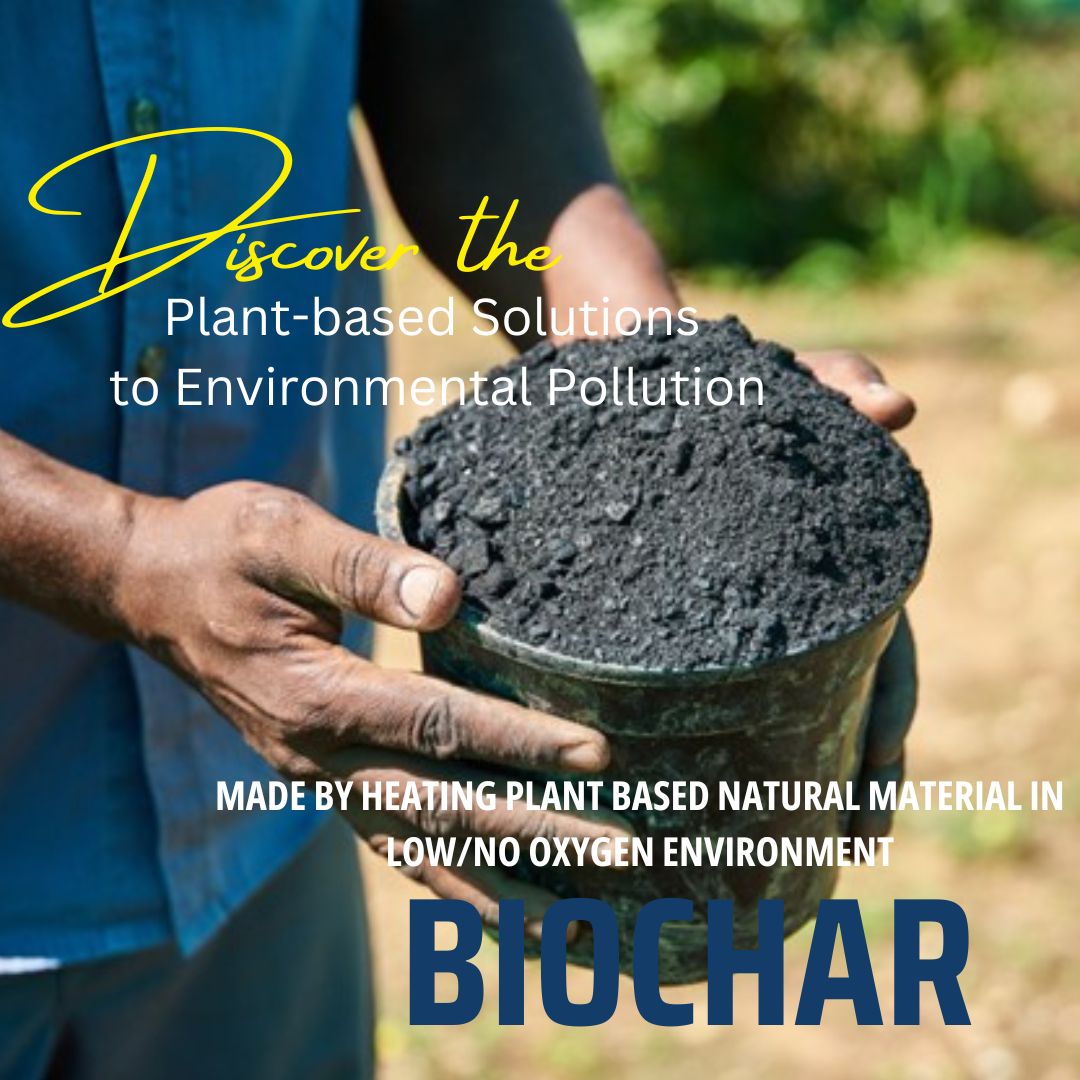
To offset this limitation, scientists took plant waste a step further. They burned the plant material. Yes, you heard that right. Plant waste, like peels are heated to high temperatures in the absence of oxygen to create a solid that resembles charcoal. This harder, rock-like material is rich in carbon and full of microscopic pores that bind metal strongly. Unlike its soft(plant waste) predecessor, biochar lasts longer, is reusable, and can handle a greater chemical load. It is also hardy enough to use over time in running/flowing water and is chemically stable enough not to rot. It can achieve performance comparable to commercially produced activated carbon under optimized conditions, and it is expected to have a lower carbon footprint compared to conventional activated carbon. Scaling up biochar production does require energy input, particularly during thermal activation; since it immobilizes rather than degrades metal ions, it becomes a secondary hazardous material that must be handled carefully. In one such innovation, a team of researchers in India utilized lemon-activated carbon made from lemon peels to extract lead ions from e-waste leachate. The team found that close to 89% of lead in the leachate could be removed by the LAC if the pH was consistently maintained at a level of 6. They also found that the LAC could be reused multiple times while retaining approximately 75% of its efficiency.
Dr. Athavan Anand, Senior Researcher-Chemistry, Prayoga Institute of Education Research, and one of the authors of this study, is optimistic about the potential of biosorption and biochar as a valuable component of the recycling process.
“Biochar-based biosorption does not replace existing recycling technologies, but it complements them. It offers a low-cost, scalable way to manage metal-laden leachates, particularly in decentralized or resource-limited settings, where conventional treatment methods are difficult to implement,” he says.When waste itself becomes part of the solution, recycling moves one step closer to a true waste-to-wealth model.
References :
- Government of India. E-Waste (Management) Rules, 2022. Ministry of Environment, Forest and Climate Change; 2022.
- Divahar, R., Meenambal, T., Mary, J. S., Raj, P. A., Sangeetha, S., & Anand, S. a. A. (2024). Lemon peel activated carbon: A sustainable solution for lead ion removal from E-waste bioleachate. Sustainable Chemistry for the Environment, 6, 100094. https://doi.org/10.1016/j.scenv.2024.100094
- Sthiannopkao, S., & Wong, M. H. (2013). Handling e-waste in developed and developing countries: Initiatives, practices, and consequences. Science of the Total Environment, 463–464, 1147–1153. https://doi.org/10.1016/j.scitotenv.2012.06.088
- MeitY, Government of India. Electronic Waste and India. PDF report; 2024.
- Mojiri, A., Zhou, J. L., Ohashi, A., Ozaki, N., Kindaichi, T., & Li, S. (2021). Treatment of landfill leachate with different techniques: A review. Journal of Water Reuse and Desalination, 11(1), 66–84. https://doi.org/10.2166/wrd.2020.092
- Pradhan JK, Kumar S. Environmental risk assessment of heavy metals from informal e-waste recycling areas, Delhi, India. J Hazard Mater. 2014;186(1):481–490.
- Xie S, et al. Biosorption of heavy metal ions from contaminated wastewater: an eco-friendly approach. Green Chem Lett Rev.
- Karnwal A. Unveiling the promise of biosorption for heavy metal removal. Desal Water Treat.
- Aslam A, et al. Microbial biosorption: a sustainable approach for metal removal and environmental remediation. Int J Environ Sci Technol.
- Gulliani S, et al. Recovery of metals and valuable chemicals from waste: chemical leaching strategies. RSC Sustain.
- Wang, J., & Qiao, Z. (2024). A comprehensive review of landfill leachate treatment technologies. Frontiers in Environmental Science, 12, 1439128. https://doi.org/10.3389/fenvs.2024.1439128
- Bengaluru’s Mitganahalli: A ticking waste bomb defused for now. (2025, March 16). New Indian Express. Retrieved from https://www.newindianexpress.com/states/karnataka/2025/Mar/16/bengalurus-mitganahalli-a-ticking-waste-bomb-defused-for-now
- Dadumajra landfill: Chandigarh pollution committee flags poor waste management with NGT. (2025). Hindustan Times. Retrieved from https://www.hindustantimes.com/cities/chandigarh-news/dadumajra-landfill-chandigarh-pollution-committee-flags-poor-waste-mgmt-with-ngt-101762113418101.html


You must be logged in to post a comment.